LRBA Bare Trust: What a Practice Drafts and Checks
Before an SMSF borrows, the holding trust must exist. Here is what an LRBA is, what the bare trust deed must do and what to check on a fund you inherit.
- Published
- Updated
An LRBA is a limited recourse borrowing arrangement that lets an SMSF borrow to buy one eligible asset. A holding trust holds legal title for the fund. The lender’s recourse against the fund trustee is limited to that asset.
What an LRBA is and What the Holding Trust Does
The holding trust separates legal title from the self-managed super fund’s beneficial interest while the borrowing continues. It is commonly called an SMSF bare trust. The fund receives the asset’s income and records its expenses, even though the holding trust trustee appears on title.
Sections 67A and 67B of the Superannuation Industry (Supervision) Act set out the borrowing exception and permitted replacement assets. Section 67A requires the fund trustee’s right to acquire legal ownership through payments. It also restricts recourse by others, including a guarantor seeking reimbursement from the fund trustee.
New real-property borrowing arrangements subject to the amended law require business real property. A factory unit’s actual use must satisfy that test. A commercial description in a sales brochure does not establish it. The enacted amendment’s application rules preserve qualifying earlier arrangements, refinancing and acquisitions under earlier arrangements. Keep the signed contract and borrowing records needed to establish which rule applies.
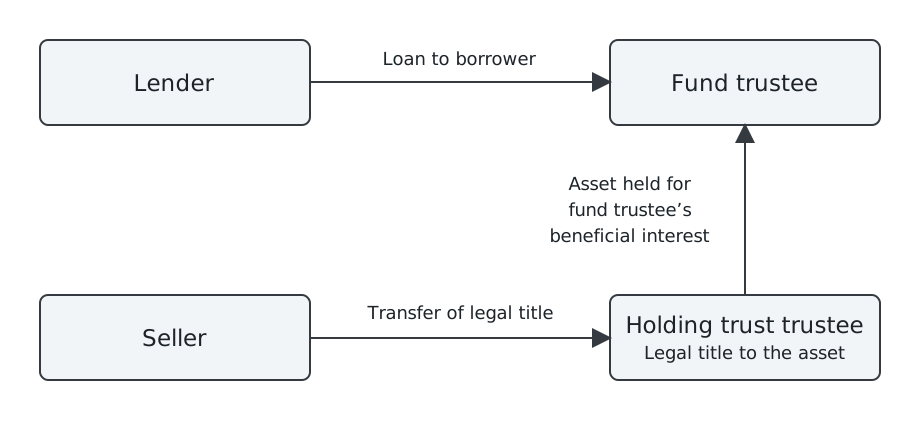
The diagram shows the fund trustee as borrower. The lender provides the loan, and the fund trustee provides the purchase money through the settlement arrangements. The seller transfers legal title to the holding trust trustee. That trustee holds the asset for the fund trustee, which has the beneficial interest and eventual title entitlement.
Drafting the Bare Trust Before Contracts Are Signed
Settle the parties, property description and proposed holding trust terms before anyone signs the purchase contract. The execution sequence needs the conveyancer’s state-specific duty advice. A universal instruction to sign the declaration first can create a second duty liability.
For an existing fund buying a factory unit, use this signing checklist.
- Check the fund deed’s borrowing powers and record the trustees’ decision under the investment strategy.
- Establish the separate holding trust trustee before it contracts to buy the property. Confirm its exact company name and Australian Company Number.
- Have the legal adviser settle the declaration, contract purchaser wording and execution sequence for that state.
- Sign the purchase contract in the approved purchaser’s name. In an NSW custodian purchase, the custodian must match the declaration.
- Execute the declaration at the advised point. Execute the loan and security documents before funds are advanced and settlement completes.
The declaration must identify the single asset, the holding trust trustee and the fund trustee as beneficiary in its fund capacity. It must preserve the fund’s beneficial entitlement and its right to acquire legal title once the debt is repaid. Read the powers and indemnity clauses against those obligations. The trust deed checklist helps you check the complete document, including amendments.
A separate company keeps the holding trustee’s legal role distinct from the fund trustee’s role. Its registration continues until the asset has been transferred out. Directors must meet ASIC’s director ID requirements. Keep its annual reviews and required changes to company details current. Use the guide to registering the holding trustee company for that separate task.
A contract in the fund trustee’s name, followed by a change to the custodian, can create further duty and title problems. Get legal and revenue assessment advice on the actual documents. Changing the name in the accounting records does not repair the purchase contract.
NSW Custodian Declaration Assessment
NSW bare trust deed stamping requires a section 62B assessment. Assess ordinary discretionary-trust deed duty and the later asset transfer under their separate provisions.
Revenue NSW’s declaration assessment rules require the fund to exist by the contract date. The declaration must name that fund and identify the property. The purchasing custodian must match the declaration, and the fund trustee must provide the purchase funding. The purchase must also satisfy the required duty assessment.
The fixed declaration duty is $750 for instruments in the current rate period. Earlier instruments can fall under the previous $500 rate or older provisions. Use Revenue NSW’s linked eligibility boundaries to identify the applicable treatment. Do not assign a concessional liability until the client’s documents satisfy its conditions.
Collect the executed declaration and amendments, fund establishment evidence, purchase contract and settlement records. Funding evidence needs the fund trustee’s full account name. Include deposit records, bank statements and the loan approval or agreement. Add the purchaser declaration and required identity evidence from Revenue NSW’s evidentiary list.
An authorised processor can use Electronic Duties Returns (EDR) for eligible straightforward declarations under the Superannuation Trust document type. Revenue NSW’s processing instructions send complex cases to eDuties using application type ‘other’. Unapproved finance, a fund established after contracting or a purchaser mismatch needs that assessment route. Changes to parties or property also require eDuties assessment. Submit the complete evidence instead of selecting a concession based only on the deed’s title.
Retain the assessment record with the borrowing file. A duty endorsement establishes the assessed duty treatment. It does not establish compliance with the superannuation borrowing rules.
Duty differs by state. Victoria’s LRBA guidance examines purchase funding and the declaration’s terms for its apparent-purchaser exemption. Its contemporaneous-transaction exemption can also be relevant. Have the relevant state revenue office’s position resolved before signing.
The Single Acquirable Asset Rule
One contract does not make several assets one acquirable asset. Check the legal rights and what the fund is actually acquiring.
The ATO’s SMSFR 2012/1 ruling gives these contrasting examples.
- Two adjacent blocks that can be sold separately remain separate assets, even when the seller insists on one sale.
- A substantial permanent factory spanning titles can be one asset where it prevents separate dealings.
- Running one farming business across several titles does not itself combine those titles into one asset.
For each distinct new asset, establish its own borrowing arrangement and holding trust. The law also permits a collection of identical assets with the same market value, such as same-class shares in one company.
Borrowed money can fund repairs and maintenance of the acquired asset. It cannot fund improvements. Restoring a damaged roof can be a repair. Adding a new storey is an improvement. Classify the work against the asset’s condition when acquired, including the extent of any change.
Fund money outside the borrowing can pay for an improvement only while the asset remains the same asset. Turning vacant land into developed premises can create a different asset and breach the arrangement. Obtain the proposed works and funding details before work starts. Do not assume section 67B lets the fund replace any property it chooses.
The Safe Harbour Interest Rate and Non-Arm’s Length Income
A related-party LRBA must be maintained on arm’s length terms. The ATO’s safe harbour establishes accepted borrowing terms. Trustees can also support other arm’s length terms with commercial evidence.
The ATO’s LRBA rate table gives 9.35% for real property and 11.35% for listed shares or units in the 2026-27 income year. Variable safe harbour rates apply by income year. Recalculate repayments when that rate changes.
PCG 2016/5 sets these other terms.
| Safe Harbour Term | Real Property | Listed Shares or Units |
|---|---|---|
| Maximum total term | 15 years | 7 years |
| Maximum loan-to-value ratio at establishment or refinancing | 70% | 50% |
| Maximum initial fixed-rate period | 5 years | 3 years |
| Repayments | Monthly principal and interest | Monthly principal and interest |
| Security | Registered mortgage | Registered charge, mortgage or similar security |
| Agreement | Written and executed | Written and executed |
Refinancing does not restart the maximum term. Deduct time under earlier loans for the same asset. A permitted fixed-rate period uses its applicable starting rate, then converts to variable terms. The annual rate table therefore does not require every valid fixed loan to reset its rate immediately.
For the annual check, compare the rate and remaining term with the agreement. Reconcile actual repayments and the closing balance. Check the original or refinancing valuation and loan-to-value calculation, including other borrowing on that asset. Identify any arrears or variation.
Missing the safe harbour does not automatically make the income non-arm’s length income (NALI). The trustees need evidence of commercially available terms for the same circumstances. TD 2016/16 explains the comparison with a hypothetical arm’s length borrowing.
Non-commercial borrowing terms can cause income from the acquired asset to be NALI. The non-arm’s length component is taxed at 45% under the ATO’s return instructions. That risk extends beyond a small adjustment to the interest deduction, so investigate departures before completing the return.
Checking an Arrangement on a Fund You Take on
Before the first lodgement for an inherited geared fund, reconcile its signed documents with its title and accounts. A loan balance in the previous accounts does not establish a valid LRBA.
Obtain these records before completing the review.
- The fund deed and all amendments.
- The holding trust deed and amendments, with duty assessments.
- The executed loan agreement, variations and registered security.
- The signed purchase contract and settlement statement.
- A current title search identifying the legal owner.
- Trustee minutes and the investment strategy.
- Purchase funding records, valuations and repayment statements.
Match the fund trustee’s identity through the deed, contract funding and loan. Match the custodian through the declaration and title. If a trustee changed, obtain the appointment and transfer records. Check the arrangement’s eligibility under the law applicable to its acquisition and borrowing.
For a related-party lender, compare the actual terms and payments with the safe harbour table. If the trustees rely on commercial terms outside it, retain their comparable lending evidence and assess NALI exposure. A favourable interest rate alone cannot establish the whole borrowing’s tax treatment.
The fund’s accounts must recognise its beneficial asset and the borrowing liability. Reconcile rent, expenses and principal repayments to supporting records. Check that the investment strategy addresses the borrowing, liquidity and ability to meet liabilities. Give the documents to the approved auditor through the SMSF audit checklist.
If the file does not hold together, write to the trustees with the exact mismatch and affected documents. Explain the potential duty, superannuation and tax consequences separately. Identify who must resolve it, what evidence you need and which return treatment remains unsettled. Seek the relevant legal advice before changing executed documents. Never backdate a missing declaration or agreement.
This review assumes the fund already exists. The SMSF establishment checklist covers the fund’s separate setup requirements.
Transferring the Asset When the Loan is Repaid
Repaying the loan gives the fund trustee the right to obtain legal title. The repayment itself does not change the name on title.
- Obtain the lender’s payout confirmation and arrange discharge of the registered security.
- Confirm the current fund trustee and holding trust trustee against their appointment records and the title search.
- Have the conveyancer prepare the transfer and evidence for the applicable state duty concession or exemption.
- Complete registration into the fund trustee’s name and confirm it with a fresh title search.
In NSW, assess the transfer under the superannuation trustee and custodian concession, including unchanged beneficial ownership. The original section 62B declaration assessment does not automatically assess this later transfer.
Victoria can exempt the final transfer under section 34(1)(b) where its corresponding apparent-purchaser conditions were established. Section 36 can apply on different facts. Confirm the correct provision and supporting evidence with the state revenue office before lodging the transfer.
File the registered transfer, discharge and duty assessment. Retain the trustees’ minutes and update the fund’s asset register for its legal ownership. Keep the historical acquisition and beneficial ownership records.
Keep the holding trustee company registered until the transfer is complete. ASIC’s deregistered company guidance explains that trust property vests in the Commonwealth when a company is deregistered. Former directors cannot then sign as the company to transfer its property. Resolve any premature deregistration through the appropriate reinstatement or trust-property transfer procedure before treating the title as corrected.
See it with your own clients in mind
Tell us a little about your practice and we’ll walk you through Tax Genie.