Entity Structure Chart: Mapping a New Client Group
Taking on a family group of companies and trusts? Map the ultimate holding company, related entities and trustees in one chart, then file each.
- Published
- Updated
An entity structure chart shows the companies, trusts and other entities in a client group, with the people who own or control them. Draw it before quoting so each entity’s work and missing records are visible.
What an Entity Structure Chart Shows
An entity structure chart is a diagram of the client group’s entities and the ownership or control links between them. A company structure chart follows shareholdings. A trust structure chart also shows who acts as trustee and who can appoint a replacement.
Include individuals, companies, partnerships and trusts, plus any self-managed super fund (SMSF). Label shareholdings and unit holdings with percentages. Draw a separate trustee link for each trust, even when one company acts for several trusts.
Use the chart to decide which entities your engagement covers and what each requires. A trading company with payroll needs different work from a company acting only as trustee. Separate files let you quote for those differences and plan each lodgment.
The people shown also guide your identity work. Follow the separate beneficial owner checks when identifying the people behind an entity.
Finding the Ultimate Holding Company
An ultimate holding company is the body corporate at the top of a subsidiary chain that is itself a subsidiary of no body corporate. Section 9 of the Corporations Act defines it. ASIC’s holding-company explanation describes the same relationship in company terms.
Start with the trading company’s members and follow each corporate shareholder upwards. Repeat until you reach a company with no corporate parent. Section 46’s subsidiary tests cover board composition, majority voting power and qualifying share capital.
A minority investment does not automatically make the investor a holding company. Record the actual rights before labelling the top company.
ASIC’s extract has an Ultimate Holding Company entry in the Officeholders and Other Roles section when one is recorded. Its extract guide also shows the members and share classes. Use the reading company extracts to collect the records behind the chart.
ASIC’s Form 484 guide has a holding-company change section. It records the name, identifying number and change date. An extract’s recorded entry still needs to agree with the group’s actual holdings.
Many family groups have no ultimate holding company. Individuals may own the trading shares directly. A corporate trustee may hold them for a discretionary trust. Section 48 disregards shares and powers held in a fiduciary capacity when testing subsidiaries.
Draw the trust above the trading company and label its shareholding as held through the trustee. Show the trustee separately with a trustee link. Do not label it a holding company merely because its name appears as shareholder.
Related Entities and Associated Entities
Related bodies corporate, associated entities and tax-connected entities use different tests. A line on the chart records a relationship. It does not settle every legal classification.
| Term | What the test examines | What to record |
|---|---|---|
| Related bodies corporate | Section 50 covers holding companies, subsidiaries and companies sharing a holding company | Corporate parent and subsidiary links |
| Associated entities | Section 50AAA covers related bodies, control and qualifying investments with influence or materiality conditions | Rights and facts supporting the relevant limb |
| Connected entities | Section 328-125 tests control of one entity by another or common control | Voting, income and capital rights, including indirect links |
| Affiliates | Section 328-130 tests individuals or companies acting on another’s wishes or in concert in business affairs | Evidence of how the businesses actually operate |
The Income Tax Assessment Act owns the tax tests. Aggregated turnover includes relevant annual turnover from connected entities and affiliates, with statutory exclusions such as dealings within the group. Missing an entity can change eligibility for small business concessions.
For a company, the control test includes at least 40% of voting power or rights to income or capital distributions. Count relevant affiliate interests too. Partnerships use rights to net income or capital. A fixed trust’s income and capital rights also need checking.
For a discretionary trust, examine who directs the trustee and its distribution history. A recipient can satisfy the distribution test through at least 40% of income or capital paid or applied in any of the previous four income years. Include relevant affiliate amounts.
The Commissioner can determine that control does not exist in some cases where the control percentage is at least 40% but below 50%. A percentage on the chart does not itself establish that discretion applies.
Add a spouse’s company to your enquiries even if the client describes it as separate. Marriage alone does not establish the general affiliate test. Some small business capital gains tax rules have special spouse provisions.
A trust distributing to a bucket company also warrants a distribution-history check. A family trust holding units in another trust needs its unit rights shown. Neither relationship is fully explained by a list of company directors.
How to Draw the Chart Step by Step
Draw the chart from the client’s entity list, then reconcile every link with the documents. Obtain current company extracts, share registers and trust deeds with amendments. Ask about entities outside your proposed engagement too.
- List every entity the client identifies. Give each a separate entry, including dormant companies and trustee companies.
- Add entities found in extracts and deeds. Follow corporate shareholders and unit holders until each chain has an explained endpoint.
- Draw ownership lines. Label the percentage and share class or unit class, then distinguish beneficial holdings from trustee holdings.
- Add trustees and control roles. Show company directors, trust appointors and the people authorised to act for each entity. Compare trustee appointments with the deed and replacement documents.
- Review the finished chart with the client. Resolve a missing shareholder or conflicting trustee before treating that part as complete.
- Record the chart’s preparation date and version. Redraw it after an ownership change, new entity or trustee replacement and retain the previous version.
Use a consistent visual legend. Rectangles can show companies, diamonds trusts and hexagons SMSFs. Use ovals for individuals and rounded rectangles for partnerships. Solid lines show ownership. Dashed lines show trustee or other control roles, with the role written beside each line.
An Invented Five-Entity Group
This fictional example has a trading company, a trustee company, two discretionary trusts and an SMSF. Anonymous roles stand in for the people.
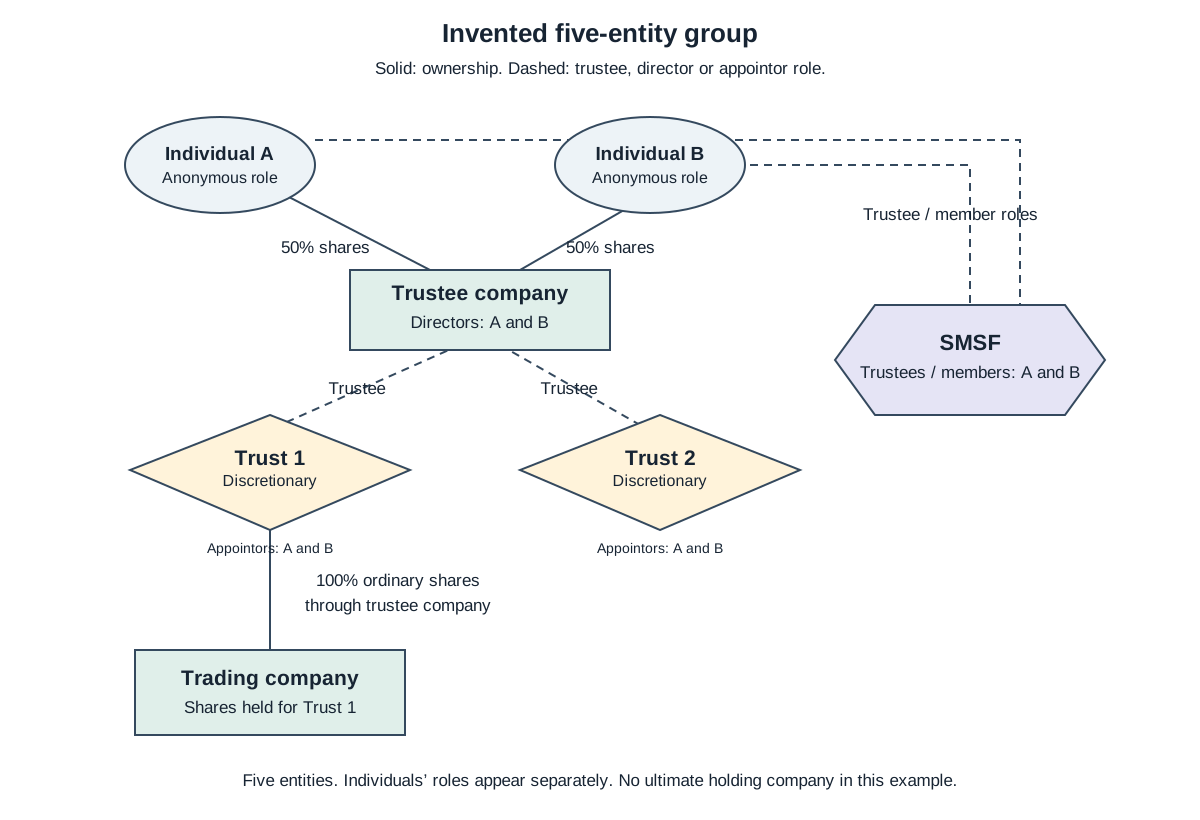
The two individuals each own 50% of the trustee company and are its directors. They are appointors of both trusts. The trustee company acts for each trust separately. The first trust holds all the trading company’s ordinary shares through that company as trustee.
The second trust holds investment assets. The SMSF has the two individuals as trustees and members. Membership is labelled separately from ownership, because a member’s fund interest is not a company shareholding.
These facts give five entity files, plus the individuals’ records. The trustee’s fiduciary shareholding does not establish an ultimate holding company. The tax control tests still need their own assessment.
Resolve Gaps Before Filing the Chart
If percentages exceed 100%, check the denominator and share classes against the register. If a shareholder is marked as holding non-beneficially, obtain the trustee or nominee evidence. Where an extract and deed name different trustees, trace the appointment documents.
The chart is ready when every entity has a file reference and every ownership or trustee line has supporting evidence. Record unresolved rights as an outstanding enquiry, with a staff owner, before quoting the affected work.
What Each Entity Needs on File
Keep a separate record for every entity, with references back to the chart. Store sensitive identifiers in the protected client record, outside the diagram shared with clients or colleagues.
| Record | What to collect or establish |
|---|---|
| Identity | Legal name, entity type, ABN and TFN where applicable, plus ACN for a company |
| People and authority | Trustee, directors, relevant director IDs, partners and authorised contacts |
| Governing documents | Trust deed and amendments, partnership agreement or company constitution where adopted |
| Ownership | Share register, classes and percentages, unit register and evidence of trustee holdings |
| Work status | Tax registrations, outstanding returns, lodgment status and services included in your engagement |
| Trust tax records | Any family trust election or interposed entity election, relevant closely held trust reporting and latest distribution resolution |
A company using replaceable rules may have no adopted constitution. Record that basis instead of leaving an unexplained document gap. Director IDs belong with the people who hold them, with links to their company roles.
For each trust, establish the trustee from the deed and later appointments. The trustee guide explains the two trustee types. Keep any family trust election with the relevant trust’s file and identify entities covered by an interposed entity election.
Tax Genie sends a guided form covering each entity and its relevant people. It checks ABN, ACN and TFN details, trustee type and director IDs. Rules and AI review the answers and return fixable issues to the client, so the practice receives checked details for each entity file.
Keep those files separate even when one client contact completes the request. An SMSF’s records do not belong in the trading company’s file simply because the same people run both.
Tools for Drawing the Structure
Choose a drawing tool that lets staff change relationships quickly, export a readable PDF and share the editable file inside the practice. Keep the editable original beside the filed PDF so the next ownership change does not require a redraw from scratch.
Lucidchart, Microsoft Visio and diagrams.net, also called draw.io, are general diagram tools. They suit a chart with repeated shapes and labelled connectors. Presentation software is another option when staff already use it and the group fits on one page.
Practice or company secretarial software can be useful when its group view draws from entity records you maintain there. Check what that view shows: shareholdings alone will miss trustee and appointor relationships. A built-in chart saves work only when its underlying records stay correct.
For a small practice, start with a plain template containing the entity shapes and line legend. A dedicated tool earns its cost when larger groups, frequent changes or several editors make manual updates slow. Export the example group first and confirm every percentage and trustee label remains readable in the PDF before adopting the template.
See it with your own clients in mind
Tell us a little about your practice and we’ll walk you through Tax Genie.